Wednesday, October 13, 2010

Preparing for Blue Berries on the Homestead

Well we are preparing the field for blue berry plants.  Why did we choose to plant blue berries you may ask.  I will tell you.  We were looking for a crop we could grow that is not your typical crop.  Something people would want but not many people are supplying.  After hours and hours on the Internet and reviewing extension suggestions for alternative cash crops I came up with blue berries.  The reasons are twofold.  Great potential for profit and increasing consumer demand.

Blue berries may be eaten fresh.  Made into jellies or jams, syrups and juices.  And also make a decent pie.  They freeze well and do not stick together when frozen unlike other berries.  Did I mention that they taste good?  There are also many well know health benefits from eating blue berries.

Health Benefits:
  • Blue berries aid in reducing belly fat
  • Blue berries are rich in antioxidants which naturally boost your immunity
  • Neutralize free radicals which may help reduce disease and fight the effects of aging
  • Preserve vision.  Blue berry extract contains compounds called anthocyanosides which may slow visual losses.  Better than eating carrots in my opinion!
  • Promotes the health of the urinary tract
  • May help heal and prevent neurotic disorders by preventing the deterioration and death of neurons.  Family history of Alzheimer's disease?  How about a cup of blue berries.
  • Combats heart disease by dissolving bad cholesterol and strengthens the heart muscle fibers
  • Combats constipation and aides in digestion due to the high fiber content
  • Blue berries contain certain chemicals that may repel certain types of cancer such as colon and liver cancer
  • And did I mention they taste so good? 


Selecting the Site

Blue berries require full sun and a well drained soil.  You can not expect a plant to do well in shade or in an area that remains wet.  Most of a blue berry plants roots are in the top 8 inches of soil so your planting area need not be deep but should be 2.5 to 3 feet wide.  You also want to keep the weeds away from your blue berry plants so they do not have to compete for water.  As you can see in the picture below the site we chose is a slightly sloping area with full sun.  The picture was taken at dusk and the area that we are planting receives full sun from sun up to sun down.


Preparing The Soil
You can not just go out to the local nursery, purchase your blue berry plants and stick them in a hole in the ground.  The soil has to be prepared first.  Blue berries require a very acidic soil.  If the ph of the soil is to high the plants will not do well or will more than likely die.  The recommended ph for blue berry plants is 4.8 but anywhere from 4.0 to 5.0 will work.  Very few spots in our location in the Ozarks have a naturally low ph so some amendment is probably going to be required.  Blue berry plants also like lots of water but do not like to be kept in a wet environment.  This means you want to water blue berry plants well but they must be in a well drained soil.  If your site is not well drained you may create a mound to plant the bush in as long as the plant is 6-8 inches above grade.

Methods of Lowering PH 

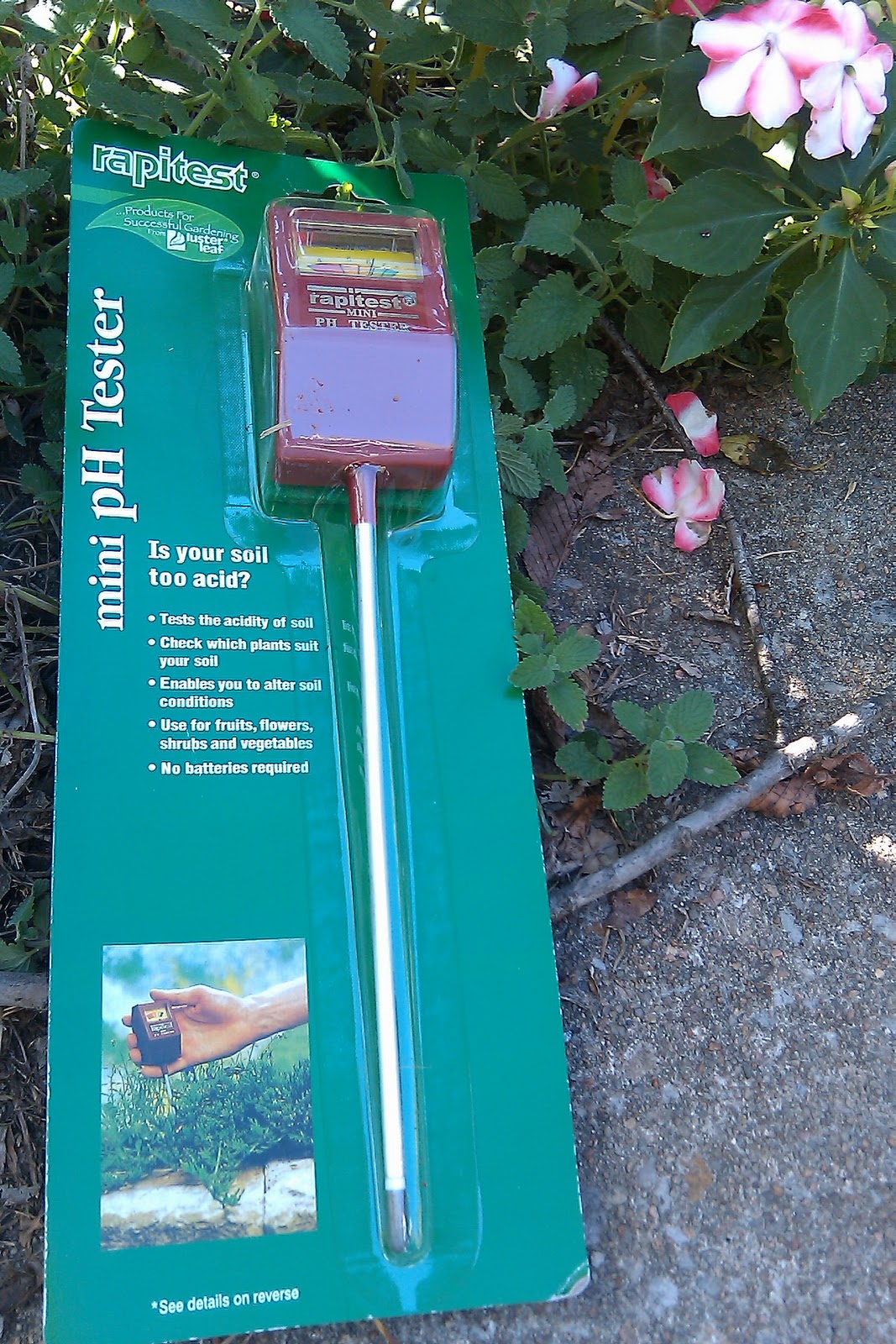
As discussed a blue berry plant has to have an acidic soil to grow and do well.  Does this mean you can go till up a spot, lower the ph and immediately plant the bushes?  You probably can but they may not do well.  It is more beneficial to prepare the soil 3-4 months before you plan on planting.  For you average home grower you would typically plant blue berry bushes in the spring.  For commercial growers it is recommended to plant in the fall.  There are several ways to lower the ph of your soil but they all begin by testing the ph of the soil.  In our case we purchased a ph tester from Ace Hardware.  It is simply a rod you stick into the soil with a meter attached.  I cost less than $10.00 and will more than pay for itself.

Using a wettable sulfur (greater than 90% sulfur) such as garden sulfur you will use 1 pound per 100 square feet on sandy soils to lower the ph by 1 unit such as from 7.0 to 6.0.  On soils containing silt, clay, or more than 2% organic matter it will take 2 pounds of Sulfur per 100 square feet of soil to lower the ph by 1 point.  You will need to re-test the ph and keep adding the sulfur until you reach the recommended level of 4.8.  If you absolutely must plant a blue berry bush without preparing the soil months in advance you can try using sphagnum peat moss.  Sphagnum peat moss is naturally acidic, organic, and has high water retention properties.  For each plant prepare an area 2.5 feet in diameter and one foot deep.  Remove 1/3 to 1/2 of the soil and work in an equal amount of pre-moistened peat moss and mix well. 

Another alternative method is using pine mulch.  Pine mulch is naturally acidic.  In this method you will use one part pine mulch, one part peat, and one part soil.  This will reduce the amount of peat moss your require which will reduce your costs and it will create and air and water channel.


As you can see we have started tilling the first row.  After we selected the site we ran a piece of string as a guide to keep the rows somewhat straight.  It is best for the rows to be oriented in a north to south fashion but if that is not possible you may orient the rows east to west.  The rows the berries will be planted in are four feet wide and there is ten feet in between rows.  This gives us a nice sod area to walk on for picking and we can easily keep it mowed to keep the weeds down.


Here you see we have completed four rows.  Each row is 200 feet long.  We will place the berry bushes in each row with a minimum of 4 feet between each plant. 


Our plan is to plant 200 blue berry plants that are 2-3 years old when we plant.  We will be able to start producing within a year or so and will plant additional plants each year to increase our production.  We plan to initially sell at farmers markets and possibly to some local stores.  As we add plants we will open a u-pick operation to increase our profits.  My next post will cover the actual preparation of the soil with the results of my soil test, addition of sulfur and peat.

Sunday, October 10, 2010

The Forquer Farm at Turkey Hollow

We have purchased our sanctuary!  This past August the family and I purchased five acres in Missouri.  It has long been our goal to at least get across the state line into Missouri to take advantage of the lower tax rates.  We have searched high and low and I have been scouring the Internet for the past several years searching for the perfect place.  About a year ago I saw and on-line ad for five acres with a creek.  I came back across the ad when I was going through old bookmarks and cleaning up my computer.  I clicked on the bookmark and the ad was still active.  I called the listing agent and was informed that lot had been purchased but they had another adjacent lot I may be interested in.  We got directions and drove out.  The kids and I were excited.  We thought from the first moment we saw it that it was the perfect spot!  Jennifer wasn't so excited about the thought of being 12 miles from town.  She was hesitant to say the least.  We decided we would wait and think about it prior to making any decision.  Jennifer said she prayed for a sign that it was the right thing to do.  We received a call from the agent the next day and she told us that the price had dropped from $22,000 to $15,000.  WOW!  I call that a sign!  Needless to say we immediately sent the down payment and closed within two weeks.

The place is what I have always wanted.  Five acres.  Half of it is open ground and the other half is forest with oak, birch, and hickory trees.  Wildlife is very abundant, we have seen turkey, deer, and other small game.  The nearest neighbor is almost a half mile away.  Perfect!


Since we purchased the land we had to purchase a lawn tractor.  And to get the lawn tractor out there we had to purchase a trailer.  I have been doing research on ways to make our land make us money and have come up with selling blue berries during the summer months when they are in season.  In the fall we will have pumpkins and gourds.  We have also talked about maybe growing mums to sell.  The possibilities are endless.  In preparation for planting the blue berry plants I purchased a rear tine tiller.  It is a Craftsman model and it works wonderful.  I tilled four rows four feet wide by 200 feet long.  I can honestly say it did not even feel like work.  The soil appears to be great with a good mix of sand and soil.  Blue berry's require a very acidic soil so we will have to work in oak leaves and use lots of peat moss when  we plant.  Otherwise they will not make it.  With the soil prepared I am researching nurseries to purchase the plants from. 

A good friend I used to work with came out and cut some brush from the front of our property along the road and he is coming out next week to put in our driveway.  We hope to have our house on the market by March 1 of next year and we will be putting in the electricity and water sometime early next spring as well.  As soon as our house sales we will be able to build our homestead.  The only problem is deciding the building method.  I have researched many:

    
  • Straw bale                                                             
  • Structural Insulated Panel             
  • Insulated Concrete Foam
  • Post and Beam
  • Log Cabin
  • Kit Home
  • Modular Home
I decided that given the fact I have had a spinal fusion and two shoulder surgeries I probably would not do to well with the straw bale idea.  I also and not convinced that I could get the level of water proofing we would need with our wet, humid climate.  Insulated Concrete foam would be nice.  It would be fireproof and nearly tornado proof but how much would I be able to really do myself?  Post and beam would be nice but it would require the purchase of a sawmill or finding timbers within a reasonable distance.  I could then incorporate the structural insulated panels for increased energy efficiency and this seems to be the direction we are leaning.  Whichever method of building we decide on we will definitely be incorporating passive solar features into the design and we will build only as big as we need.  Do we really need two living rooms, a seperate dining room, home office, and library?  The idea is to have a more open floor plan with more multi-use spaces versus rooms dedicated to a single purpose. 


View of property from the road
 Of course the girls have dreams of ponies and puppy's.  We are thinking about using goats to clear the underbrush from the forest.  Jennifer has always wanted some chickens so she will finally have her chance.  The only question is how to keep the coyotes away.  I have also read that geese are good to eat the weeds and bugs out of the berry patch.  There is so much to learn.  I really know nothing about farming but you have to start somewhere.  All we know is that we are finally fulfilling our dream of being in the country and being more self sufficient.  It will not be easy, it will not be cheap, and it may take longer than we can even imagine but I do know that we will be better off in the end!  When are you going to fulfill your dreams?


A view of our property


Sunday, July 11, 2010

Water Water Everywhere Not a Drop to Drink

The Problem

Our last post covered options for lighting our home with modern bulb technology.  This week we will cover ways to save money in regards to water.  In our community we are billed a sewer fee for all of the water that flows from the city main through your meter.  What if the water you used did not find its way back into the city sewer system?  A good example would be the water you use to water your lawn or garden or the water used for filling a swimming pool.  It does not matter!  You pay the sewage fees no matter where the water goes or what it was used for.

Our Solutions:

Clothing Care

It was only after our family size grew and we noticed a dramatic increase in our water bill did we begin to question ways to save.  One of our biggest water saving moves was when we purchased a new clothes washing machine.  Prior to this we used the standard top load washer that used gallons and gallons of water.  In late 2008 after conducting much research on washing machines we made our selection.  The model we selected was the Whirlpool Duet Sport.  This washer uses less water and energy to operate than the standard top loading model. When the machine was delivered and after it was set up we spent hours just watching it wash clothes.  I was amazed by how little water it uses.  All you have to do is select the type of load you are doing, fill the fluids and watch it go.  Its too bad they have not figured out how to make a washer be self loading.


 Features:
  • Energy Star qualified
  • Large stainless steal drum
  • 7 cycles, including whitest whites, heavy duty, normal/casual, quick wash, delicate, drain/spin, rinse/spin
  •  It is ultra-efficient! Uses 60% less water and almost 70% less energy than the standard top loading washer
  • It has a delay mode that you can set for up to 6 hours in the future.  This feature is useful in communities that offer off peak water rates
  • Care control temperature management.  It senses the optimal temperature for each cycle of the wash.  This ensures that the water is at the right temperature for the detergent and maintains the water temperature at a level safe for the type of load you are doing
  • Automatically dispenses detergent, fabric softener, and bleach.  All you do is fill the appropriate section prior to starting the load
  • Ultra capacity.  If you have a large family that does lots of washing this is a feature you will love!
  • Clean Washer Cycle to keep the washer clean and sanitized
  • Uses less detergent!  We were amazed at how long one bottle of detergent lasts, it is unbelievable.
We have found that the washing machine is quiet and handles the largest loads without problem.  We have not had any problems with this washer and would recommend it to any of our friends or family!

Personal Hygiene:

Another way I found to save our family money was with a low flow shower faucet.  Some experts say that showering can account for up to 25-33% of a homes water use.  My wife was against the idea of restricting the flow of water to the shower because she loves to relax with a nice shower and really loves the rain type shower head.  I did some research and found that no matter what style we chose we would be getting a more efficient shower head than what we had.  The government regulated shower heads and all new devices must use no more than 2.5 gallons per minute at 80 psi or no more than  2.2 gallons per minute at 60 psi.  Our old shower head was old.  I learned that any shower head manufactured prior to 1992 used at least 5.5 gallons per minute so any option we chose would realize a savings of at least 50%.

Types of low flow shower heads:
  • Laminar flow:  the shower head creates individual streams of water
  • Aerator shower heads:  mixes air with water to create a misty spray
  • High pressure shower heads:  use the venturi principal to increase the velocity of the water coming out of the shower head


As you can see there are many choices for energy saving shower heads.  You are sure to find the style and design you want at any price point.  Installing the new shower head is easy and takes only minutes to do.  By changing out your shower head you will also realize savings in energy used to heat the water.  You will be using less water and that translates into less energy to heat that water.  So yes honey, you can have your rain shower and take as long of a shower as you want, or at least until the hot water runs out!


The Topic Nobody Wants to Talk About, the Toilet


How old is your toilet?  Many of us may think that if it is not broken don't fix it.  This can be a costly mistake as the old toilet technology was a water hog!  Many European countries outlawed these outdated models and mandated reduced flow flush technology.  Our old toilet used 5 gallons of water per flush.  For a family with multiple kids each flush really adds up.  Americans use about 4.8 billion gallons of water every day just to flush.  I did research on what our options were and found there were many options available.

  • Dual Flush Toilets
  • Low flow Flush Toilets
  • Conversion Kits to change your toilet into a Dual Flush or Low Flush Toilet
We chose a low flush toilet made by Glaciar Bay.  This toilet looks like any other toilet but uses only 1.6 gallons per flush.

Check out this link for the many styles available:  Toilet Options


Conclusion

By making these simple changes we were able to cut our water bill from an average of $100 per month to less than $40 per month.   In the future I hope to be able to make changes to the way we heat our water to further reduce our utility costs.

How much water do you use in your household?  Check out this neat tool to calculate your usage:
Water Use Calculator


    Wednesday, July 7, 2010

    What's With The Name Kan-Green

    I have been asked what the name of my blog means. The first portion, Kan, stands for two things. The first being Kansas which is where I live. The second is that I believe that anyone can be green. It does not take much effort to live a more sustainable lifestyle. A good place to start is with your choice of bulb to light your home. The typical American home uses 25% of their home energy budget on lighting! Saving money could be as easy as switching your antiquated incandescent light bulbs to one of the newer energy efficient styles. We have many different options which I will outline below:

    Incandescent bulbs:

    Pros:
    1. Cheap
    2. Widely available
    3. Come in many different shapes, styles, and colors
    4. Produce a soft, soothing light in all directions
    5. They cool almost immediately when turned off

    Cons:
    1. Old technology from the late 1800's
    2. Rely on heating a filament to produce light
    3. Short life span, up to 1,500 hours
    4. Produce heat, not good in regards to attempting to keep your home cool
    5. Consume 2-3 times more energy than the newer alternatives


    Halogen Light Bulbs:

    Pros:
    1. Brighter
    2. Most closely imitate the light from the sun
    3. Smaller
    4. Longer life than incandescent up to 2,500 hours
    5. They recycle themselves

    Cons:
    1. Like incandescent bulbs they rely on heating of a filament to produce light
    2. Waste gas and electricity in heat energy released from the bulb
    3. Due to safety issues they should never be used in lamps or a children's room
    4. Should never be used near flammable objects

    Fluorescent Bulbs

    Pros:
    1. Available in a wide variety of shapes and sizes
    2. More energy efficient than incandescent or halogen bulbs
    3. Last 15-20 times longer, up to 25,000 hours and use 40% less energy than incandescent or halogens
    4. The light is softer and warmer than traditional fluorescent bulbs

    Cons:
    1. Light is not as warm or natural as incandescent bulbs
    2. Lamps and fixtures tend to cost more as a ballast is required
    3. Life is shortened by frequent turning on and off
    4. Has been connected to the fading of paintings due to high uv output
    5. May not turn on in extremely cold temperatures
    6. Contain mercury and phosphur materials

    Compact Fluorescent Bulbs

    Pros:
    1. Saves approximately $30 in energy costs over its life span
    2. Pays for itself in 6 months
    3. Uses 75% less energy and lasts 10 times longer than incandescent bulbs
    4. Less expensive than other higher efficiency bulbs
    5. Versatile as they can be used anywhere an incandescent bulb is now used

    Cons:

    1. Sensitive to frequent turning on and off
    2. Not all CFL's can be used with dimmers or timers
    3. Can only be used outdoors if covered or shaded
    4. Contain mercury which is toxic to you and the environment


    Light Emitting Diodes (LED) Bulbs

    Pros:
    1. They do not get warm
    2. There is no filament
    3. Long life lasting 10 times longer than CFL bulbs
    4. Last up to 60,000 hours
    5. Cost of power for 60,000 hours - $12.00
    6. Durable. There is no filament to break thus they last far longer
    7. Mercury free

    Cons:
    1. Generally less bright than traditional bulbs
    2. Has a very direct field of light. Useful for task lighting, not so much for lighting a room
    3. High production cost leading to high cost to purchase


    Fact: If every American home replaced just one light bulb with an Energy Star qualified bulb, we would save enough energy to light more than 3 million homes for a year, more than $600 million in annual energy costs, and prevent greenhouse gases equivalent to the emissions of more than 800,000 cars.

    Fact: A report by the International Energy Agency found that a global switch to energy efficient lighting would trim the worlds electricity bill by one-tenth. The carbon dioxide emissions cut would be more than those produced by the current use of solar and wind technologies combined!

    Fact: 19% of global energy use is for lighting.

    Fact: Replacing a single incandescent bulb with a CFL will keep half a ton of CO2 out of the atmosphere over the life of the bulb.

    Fact: If every household in the United States used energy efficient lighting we could shut down 90 average size power plants!

    Want to learn more? Check out these links:

    http://eartheasy.com/live_energyeff_lighting.htm

    http://www.energystar.gov/index.cfm?fuseaction=find_a_product.showProductGroup&pgw_code=LB

    http://www.treehugger.com/files/2008/04/energy-efficient-light-bulbs-save-water.php

    Monday, July 5, 2010

    Huff and Puff All You Want, You Will Not Blow Down My Dream House!

    I like to think that I was green before green was cool. I have always asked myself why we work so hard to hand our hard earned money over to others? Americans on average work more hours than any other industrialized nation. We get less vacation, sick, and maternal/paternal time than any of the other nations. If you are like myself and are not independently wealthy, you may have become a slave to employment.

    In the past decade the price of all goods has risen at an average of 3.8% annually. Do you remember filling up your car for a twenty? How about those trash bags, diapers, and all of the other petroleum based products? My rate of pay and 401-k have taken a beating. Based on inflation I am earning less than I was prior to our economic downfall. Our government denied the fact that our country was sliding into the worse financial crisis we have ever faced. The very people who perpetuated the attacks on our soil are the ones that pushed us to the edge of the cliff and they are the very ones controlling the spigot to the oil we have been conditioned to think we need! We are enslaved by big oil and despite all of the rhetoric in Washington, I do not trust those who take money from the big oil/big industry lobbyist to look after my best interests. How long did it take our elected leader to admit that the tragedy in the Gulf of Mexico was the worse ecological disaster to ever afflict us? Take a look back a few years when ethanol was the big rage. When I first moved to Kansas all you would see for miles around was wheat. Well the corn producers lobbied successfully for subsidies for ethanol plants and now what do we have? Miles and miles of corn. Not to eat mind you but to turn into fuel. Never mind the fact that it is more energy intensive to turn corn, a food crop, into fuel. How about the bio-diesel plans? More lobbying and subsidies for bio-diesel plants and we turn another food crop, soy beans, into fuel. Guess what happened to a local co-operative bio-diesel production facility when the subsidies were not continued? They were unable to pay the farmers for their product.

    How much do you pay to heat your house in the winter? My wife and I purchased a house built around the turn of the century. Our first few years here were miserable. In the winter we could not keep it warm and in the summer we could not keep it cool. We had natural gas bills over $700 per month! Don't even ask how much the electric bill was to cool it.

    Despite our best efforts at installing energy efficient windows, house wrap, new siding, and insulation we still do not have a home that works for us to keep our hard earned money in our pockets. It is time for our personal Declaration of War against outdated home design, co-dependence on foreign oil, waste and wanton destruction of our country, and use a common sense approach to using nature to our advantage to heat, cool, and light our home. We do not have a choice, our children's futures are at stake.

    When will you Declare Your Personal War and Start Investing in Your Families Future?